

Competition category RoboMission
former name until 2021: Regular Category
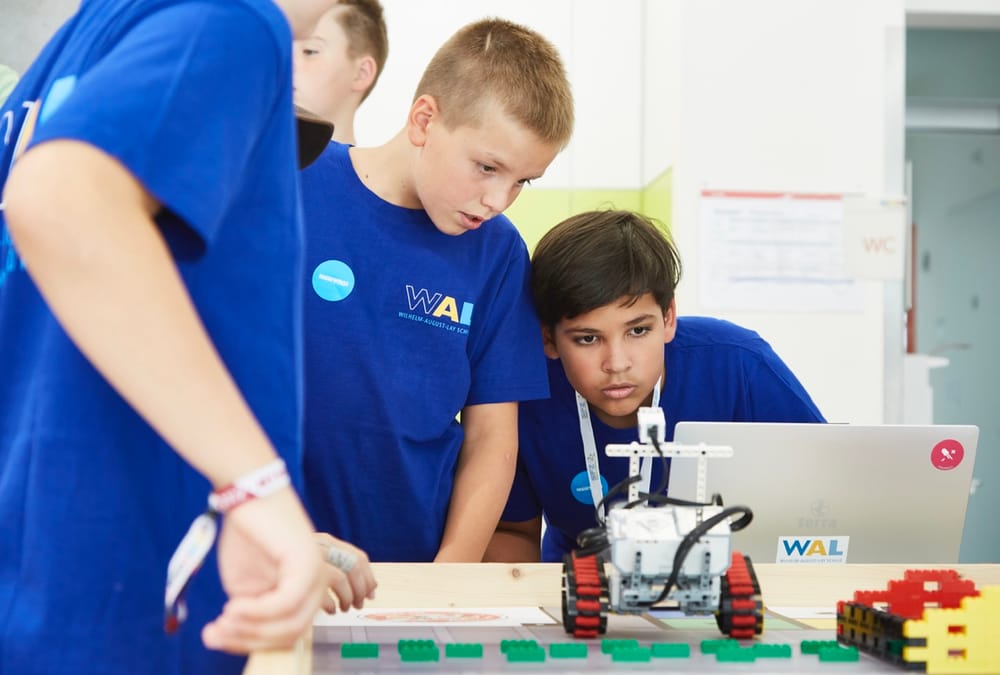
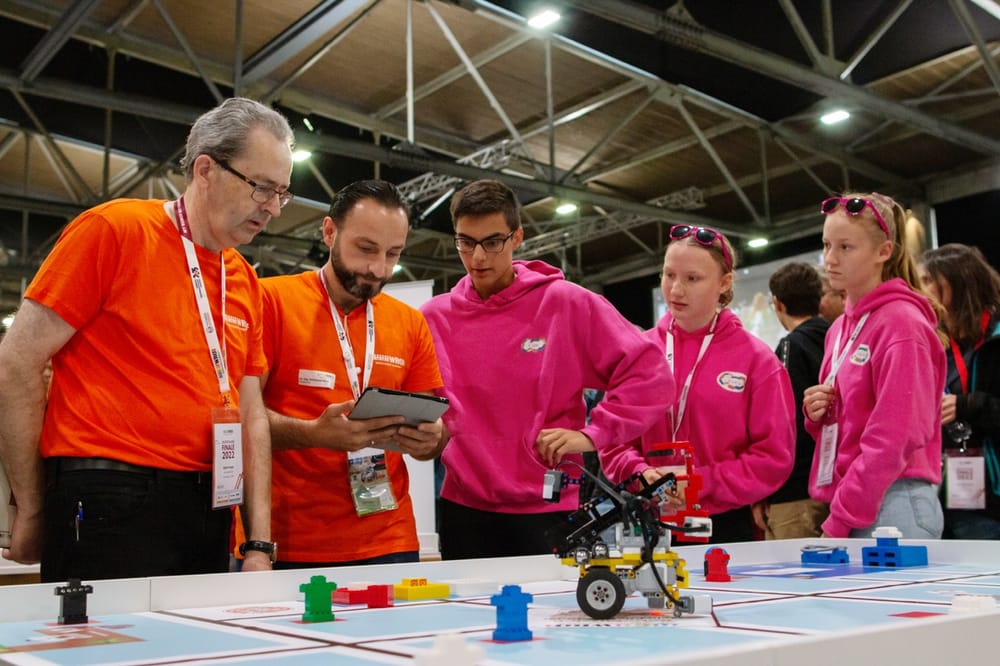
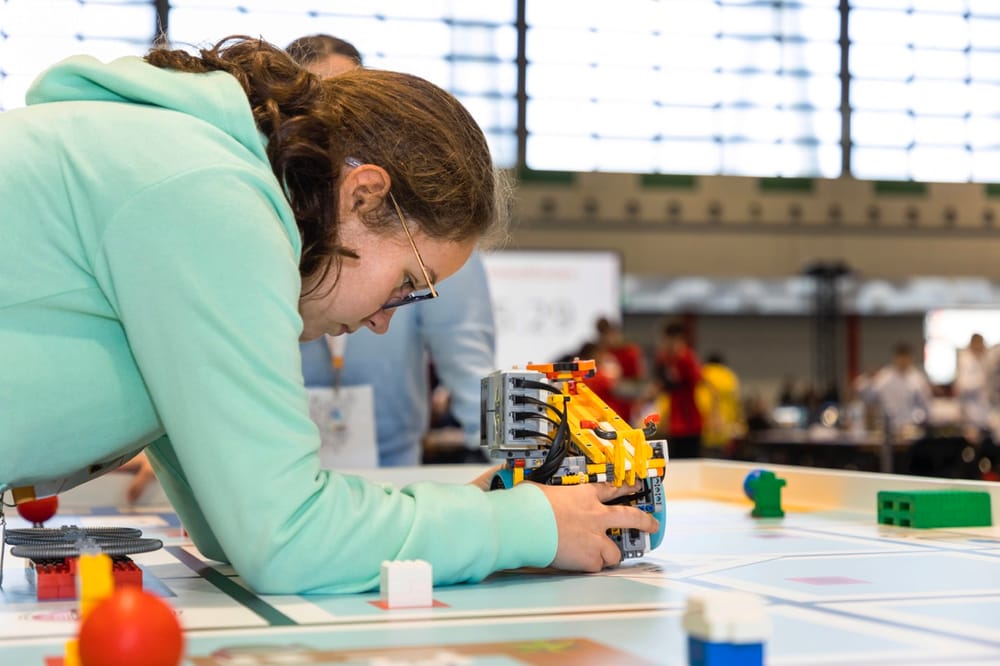
In the RoboMission, children and young people build and program a robot in teams of two or three.
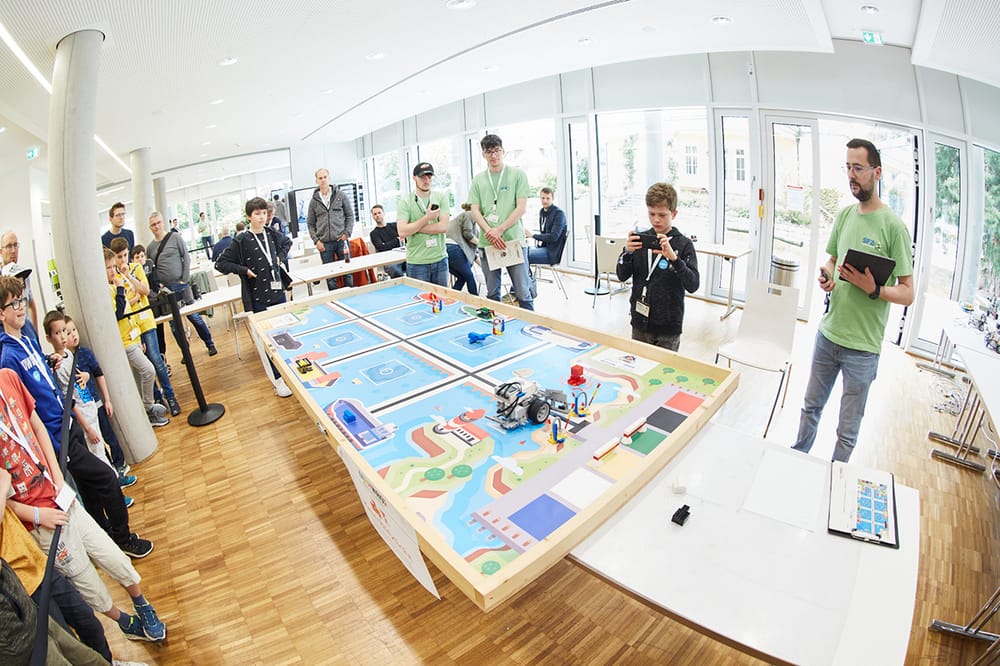
The robot has to solve tasks on a 3m² course, such as transporting objects or sorting them by size or color.
There are courses of varying difficulty for the three age groups: Elementary (8-12 years), Junior (11-15 years) and Senior (14-19 years).
Further components, special features and information on necessary materials and costs in this category can be found on this information page and in our explanatory video here on the side.
Current note: All robots are allowed in the RoboMission category from the 2025 season . Until the new rules are published on January 15th, there is already an excerpt of the new rules with details on the requirements for robots for the 2025 season . It has also already been decided that a RoboMission competition in the future will consist of seasonal tasks (published in January) and daily tasks (published during the competition). We have put together an information page on the new competition mode that contains all the important changes.
Special features of this category
All Robots Allowed
The teams are allowed to use all robot systems and bring the robot to the competition fully built. Until the new rules are published on January 15th, there is already an excerpt of the new rules with details on the specifications for robots for the 2025 season . The programming can also be brought along and adapted and further developed on the day of the competition.
Daily Task
Each competition has a daily task to which the teams can respond by making changes to the robot (by building and/or programming) or by using a different tactic. There is more information about the daily task in the "Daily task at the competition" drop-down box at the bottom of the page.
2nd-Day-Challenge
A special challenge awaits the teams at the USA final. On the second day of the competition, they are given a new task on the already familiar playing fields, so the team members can show whether they really understand and can adapt their robot.
Mode/Procedure
The competition mode will be adjusted for the 2025 season. There will be no assembly from individual parts and there will no longer be a surprise task. Instead, there will be a daily task in the afternoon. This will be explained in more detail below.
Publication of the Seasonal Tasks
The seasonal tasks are published every year on January 15th. This is the starting signal for the teams' preparation period. In the time leading up to the regional competition, the teams work on the seasonal tasks, build and program their robots and try to score as many points as possible.
Competition Day
The competition day is divided into several practice phases, in which the robot can be worked on, and the robot runs, in which the robot solves the tasks on the course and collects points. In the first two competition runs (in the morning), the teams can show how well they have prepared for the familiar seasonal tasks. The daily task is then announced. What exactly the daily task is is explained in detail in the next box. Teams then have a 120-minute practice phase in which they can adapt their robot and programming to the new tasks. The daily task also includes two scoring runs.
Daily task in the competition
The Daily Task is a new element that will be introduced with the 2025 season.
Regional competitions
The daily tasks take place on the existing playing field, but the playing field objects are redistributed and have to be brought to other destinations. This gives the teams a new task that can be easily solved with their existing robot. The team members can then show in the daily task that they can master their robot and adapt it to the new tasks. We will try to design simple tasks that are easy to do and can be completed with the existing robot.
There is a new daily task in each age group for each day of the competition. In preparation, you can think about possible tasks in your team and consider how you would solve them.
Summarized example of a daily task and an explanation in a video:
USA Final
The best teams from the regional competitions come together at the WRO Final and compete for starting places in the world final. Due to the two-day WRO Final, the daily task will be a 2nd Day Challenge with a slightly higher level of difficulty. The basic principle is the same. Some of the already known playing field objects will be used to create a new task. However, it can also happen that objects have a different color or that new, previously unknown playing field objects are added.
tasks for the 2025 season
The tasks for the 2025 season will be published on January 15th. The theme of the season will be announced in early December.
Until then, we will have to wait or look at the tasks of the 2024 season .
Age Groups
Teams can compete in three different age groups at RoboMission.
- Elementary: Participants aged 8-12 (in the 2025 season: born between 2013 and 2017)
- Junior: Participants aged 11-15 (in the 2025 season: born between 2010 and 2014)
- Senior: Participants aged 14-19 (in the 2025 season: born between 2006 and 2011)
Important: The decisive factor is the year of birth and not the age on the day of the competition.
Each age group has its own course that meets the respective requirements. Accordingly, the teams only compete against other teams within their age group.
costs for participation
One-Time Costs
To participate in RoboMission, teams must consider the one-time purchase of materials. The materials listed here can be reused over several years.
- Robots e.g. WRO® Education SPIKE Prime or WRO® Robotics TXT 4.0
- Game table
- WRO material sets * for the task objects *
* Note: Since 2023 there is a supplementary set which is additionally required to set up the task objects for a playing field.
Annual Costs
The following costs apply for annual participation in the RoboMission:
- WRO participation fee (see section "Participation costs for all teams")
- Playing field mat for the respective age group
participation costs for all teams
Regardless of the competition category, there is a participation fee per team (not per person!). This is independent of the number of teams per school/institution and is due immediately after registration. The participation fee is used to cover our organizational costs as well as the purchase of certificates, trophies and the corresponding logistics. The registration fee is currently €125.00 including 7% VAT (2025 season) per team.
For teams that qualify for the USA final, there is an additional fee, which helps cover the costs of a two-day USA final with catering for the team and coach in a larger location. After registration or after qualifying for the USA final, the team coach will automatically receive an invoice as a PDF file by email.
gaming table construction
Game table for RoboMission and the Starter Program
The game table mentioned under "Costs for Participation" is special equipment for teams. The game table is a wooden board with screwed-on boards around the outside. The table is used in RoboMission and the Starter Program in an identical design. In both categories, the respective playing field mat is placed on the game table.
The gaming table does not have to be brought to the competition. There are enough gaming tables available at the competition and there is no space available to bring or set up your own tables.
The teams can build the game table in different variations. We have put together a document with tips for this .
Of course, it is also possible to build the table in a different version than those shown here. The following must be taken into account: The inside dimensions of the table, i.e. the area between the boards, are 237.0 cm x 115.2 cm, the board height is 5.0 cm (for RoboMission & the starter program).
Important: The decisive factor is the year of birth and not the age on the day of the competition.
Each age group has its own course that meets the respective requirements. Accordingly, the teams only compete against other teams within their age group.
Free choice of programming language
There are no restrictions on the choice of programming languages at RoboMission. The teams can freely choose from any type of programming language, whether graphic-based or text-based.
However, we would like to point out that the programming software should be able to run offline on a laptop, as it cannot be assumed that the teams will have internet access during the competition. It is also recommended that the programs be transferred to the robot via cable.
WRO 2026 FAQ
Everything you need to know about the season
How does a WRO season work?
- The WRO 2026 season follows this structured competition schedule:
- Registration Opens: January 2026
- Game Rules Released: January 15, 2026
- District Championships (School Partners Only): Ontario, CA · April 17–18, 2026
- School National Championships (School Partners Only): Ontario, CA · July 24–26, 2026
- USEL Affiliate Cup: DeKalb, IL · August 7–9, 2026
- Regional Open Qualifier: Chicago, Illinois: Chicago, IL · August 12–14, 2026
- Regional Open Qualifier: Charlottesville, Virginia: Charlottesville, VA · September 5–6, 2026
- Regional Open Qualifier: Ontario, California: Ontario, CA · September 12, 2026
- Open Championship: Americas: Ontario, CA · September 25–27, 2026
- Open Championship: Asia & Pacific: Delhi, India · September 25–27, 2026
- Open Championship: Europe: Zagreb, Croatia · October 13–16, 2026
- International Final: San Juan, Puerto Rico · December 8–10, 2026
How do I register a team for the competition?
- Teams in the Affiliate Program Pathway register for each event directly with the USEL affiliate hosting it. Each event sets its own registration and fees.
- Get official WRO equipment, including competition mats, challenge kits, and table tops, in the USEL Store.
- District Championships & School National Championships: Exclusive to USEL school partners.
- A signed data protection form is required when submitting team member details.
How do I host a WRO event?
- Organizations can become USEL affiliates and apply to host sanctioned Regional Open Qualifiers.
- Every event must be approved by USEL before it is held, and affiliates handle registration for the events they host.
- Each year, affiliates can also apply to host the USEL Affiliate Cup.
- Learn more on the Affiliate Program page.
What is the USEL Affiliate Cup?
- The USEL Affiliate Cup is a national level competition held in DeKalb, IL that awards USA National Robotics Team qualification spots to both the International Finals and the Americas Open Championship.
- The traditional single US Nationals format has been replaced by two championship events: the School National Championship and the USEL Affiliate Cup. Together they form the WRO-USA national qualification structure, and each pathway earns International Final entries under WRO's published Qualification Table.
- International Finals qualification spots from the Affiliate Cup:
- RoboMission – one team from each age group
- RoboSports – one qualifying team
- Future Innovators – one qualifying team
- Future Engineers – one qualifying team
- USEL affiliates can apply to host the Affiliate Cup each year.
How do Regional Open Qualifiers work?
- Regional Open Qualifiers are hosted by USEL affiliates and award qualification spots to the WRO Americas Open Championship.
- All Regional Open Qualifiers must be approved by USEL before being held.
- Important: Regional Open Qualifiers do NOT award spots to the International Finals—only the Affiliate Cup does.
- USEL affiliates can apply to host Regional Open Qualifiers through USEL.
Can a team compete at both the Americas Open and International Finals?
- No. Starting this season, teams are no longer allowed to compete at both events.
- You must choose one path: either the WRO Americas Open Championship or the WRO International Finals.
- The Affiliate Cup awards spots to both competitions, while Regional Open Qualifiers only award spots to the Americas Open Championship.
Do I need my own robot?
- Yes, teams must provide their own robot.
- All robot systems are now allowed in all WRO categories for 2026!
- Each category has specific size and weight requirements (e.g., RoboMission: max 25x25x25cm, RoboSports: max 20x20x20cm and 1.2kg, Future Engineers: max 30x20x30cm).
How much does it cost to participate in WRO?
- Teams register for each event directly with its host, and registration fees are set by each event.
- Official WRO equipment, including competition mats, challenge kits, and table tops, is available in the USEL Store.
- For teams qualifying for international competitions, additional fees apply.
Move-in Date and Time
- District Championships (Ontario, CA · April 17–18, 2026): Day before event from 10 AM - 4 PM OR morning of event from 7 AM - 9 AM
- School National Championships (Ontario, CA · July 24–26, 2026): Day before event from 10 AM - 4 PM
- Affiliate Cup (DeKalb, IL · August 7–9, 2026): Day before event from 10 AM - 4 PM
- Please check specific event details closer to the date for exact times and locations.
How many booths are available for exhibitors?
- District Championships: Up to 15 standard 10x10 booths can fit.
- School National Championships / Affiliate Cup: More space is available, allowing for double the booths.
- Contact USEL for specific booth availability at each event.
Is parking included for exhibitors?
- Yes, exhibitors receive one parking pass. Additional passes can be requested.
Will there be WiFi and electricity?
- Yes, WiFi and electricity will be available at all competition venues.
